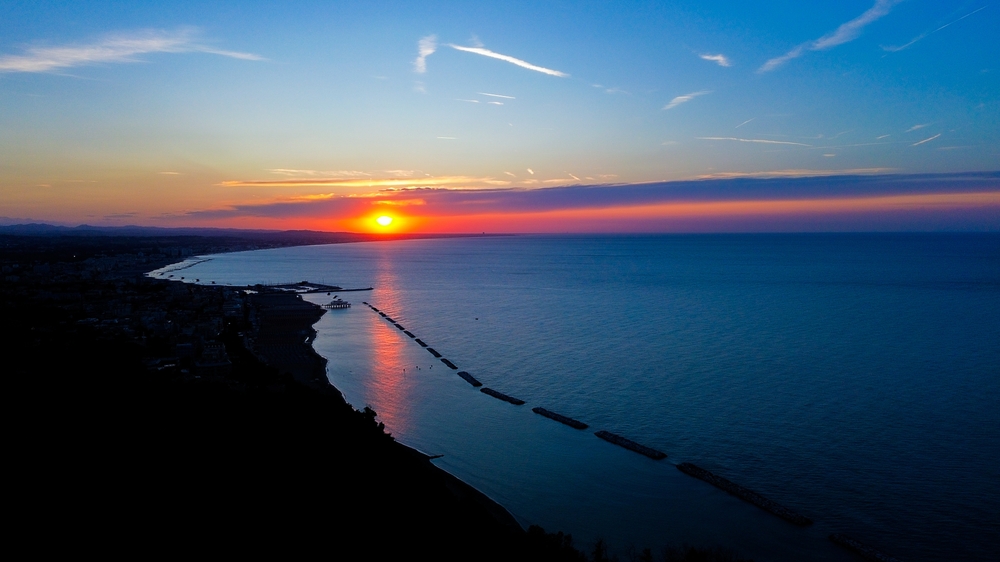
Imagine a summer evening in Pesaro: the heat subsiding, a drink in your hand, the notes of a concert coming from afar. You are sitting on the beach admiring the sun that is dipping into the Adriatic Sea … to the east. Something doesn’t quite add up. On the Adriatic coast, the sun is supposed to rise from the sea, certainly not disappear there.

Instead, that is exactly what happens. The sun slowly sets on the water in front of you. Right there, where instinct would tell you that the east is located. Possible? Actually, no. It is just a fascinating optical illusion, created by geography and made possible by the play of perspective of the coast.
Let’s start with a certainty: the Sun never sets in the east. Every day it makes its arc across the sky from east to west because of the Earth’s rotation. Only during the equinoxes (spring and fall) does it rise and set exactly at the cardinal points. For the rest of the year, those points shift: farther northeast and northwest in summer, farther southeast and southwest in winter.


This slippage is due to the tilt of the Earth’s axis (about 23.5°) and the observer’s position on Earth. It is precisely because of this mechanism that the days become longer in the summer, giving us sunsets even beyond nine o’clock in the evening.
That said, why in Pesaro and some areas of the port of Ancona does the sun seem to set in the sea to the east?
The answer lies in the conformation of the Adriatic coast. In fact, this is not a straight line. In particular, in the Marche section, the coast forms slight indentations, small gulfs.
In Pesaro, specifically, the coastline bends slightly to the northwest. That is why when observing the sea from a certain angle, especially in summer when the sun sets more to the northwest, one has the illusion of facing a portion of the sea that extends eastward.
The result? The sun slowly descends behind that body of water, and we, accustomed to thinking that in front of the sea is always the east, convince ourselves that we are seeing an eastern sunset.
Pesaro has turned this phenomenon into a cultural and scientific event. Every year, between late June and early July, the city organizes walks, concerts and observation moments to celebrate the so-called East Adriatic sunset. A natural phenomenon that has become a symbol of wonder and popularization, a small local brand that mixes poetry, astronomy and territorial pride.
Ancona’s ancient port also offers similar views, where the sun seems to lie on the sea just where it should not. No need to be an astrophysicist to appreciate its magic: just let the beauty fool you.
As we watch the sun set in the east, we learn that our perception is often shaped by mental habits rather than physical realities.
We find that:
- The sun does not move in the sky: it is the Earth that rotates.
- The coast is not a straight line, but a complex and articulated profile.
- Our gaze can be deceived despite certainties as solid as cardinal points.
And perhaps in this very gap between what we see and what is, lies the true power of science: showing us that behind every wonder there is an explanation.
Have you ever seen a sunset over the Adriatic Sea that looked wrong?
Tell us about it in the comments.
© Riproduzione Riservata